
The energy waste hidden in your buildings is becoming harder to ignore
Energy and carbon rules are tightening around the world. For building owners, the same data that supports reporting can also expose waste, lower bills and improve control.
Most buildings do not waste energy in one dramatic event.
They lose it quietly.
A ventilation system runs after the building has closed. A pump cycles more often than it should. A generator burns more fuel than its run-hours suggest. A solar system produces less than expected, but nobody notices until the monthly bill arrives. One building in the portfolio uses far more energy than another similar building, and the reason sits somewhere inside meters, schedules, logbooks and control panels.
For a property owner, this reaches far beyond the environment. It touches rent, service charge pressure, operating cost, asset value and management control.
Now there is another pressure building on top of it: energy and carbon rules are becoming stricter in many markets. Larger businesses and property owners are being asked to show clearer records of how much energy their buildings use, where that energy comes from, what emissions it creates and what they are doing to reduce waste.
The exact rule changes from one country to another. The commercial question is much simpler:
If someone asks for your building's energy record, can your team produce it quickly, accurately and with evidence?
For many portfolios, the honest answer is still no.
The real issue is visibility
The law is the pressure. Poor visibility is the daily problem.
In many buildings, the information already exists, but it is scattered. One system knows the electricity use. Another system knows the generator run-hours. Solar data sits in an inverter portal. Water pumps and HVAC equipment report to a local BMS. Electricity prices live in a spreadsheet. Monthly bills arrive as PDFs. Site engineers know what happened, but their notes are not always connected to the numbers.
By the time a report is needed, everyone starts rebuilding the story backwards.
That is expensive and frustrating. It also means waste can continue for months because nobody sees the pattern early enough.
The smarter approach is to keep a live building record throughout the year. Not a once-a-year exercise. Not a folder of bills. A working record that shows what the building used, where it was used, what changed and whether the change actually saved money.
Six questions every owner should be able to answer
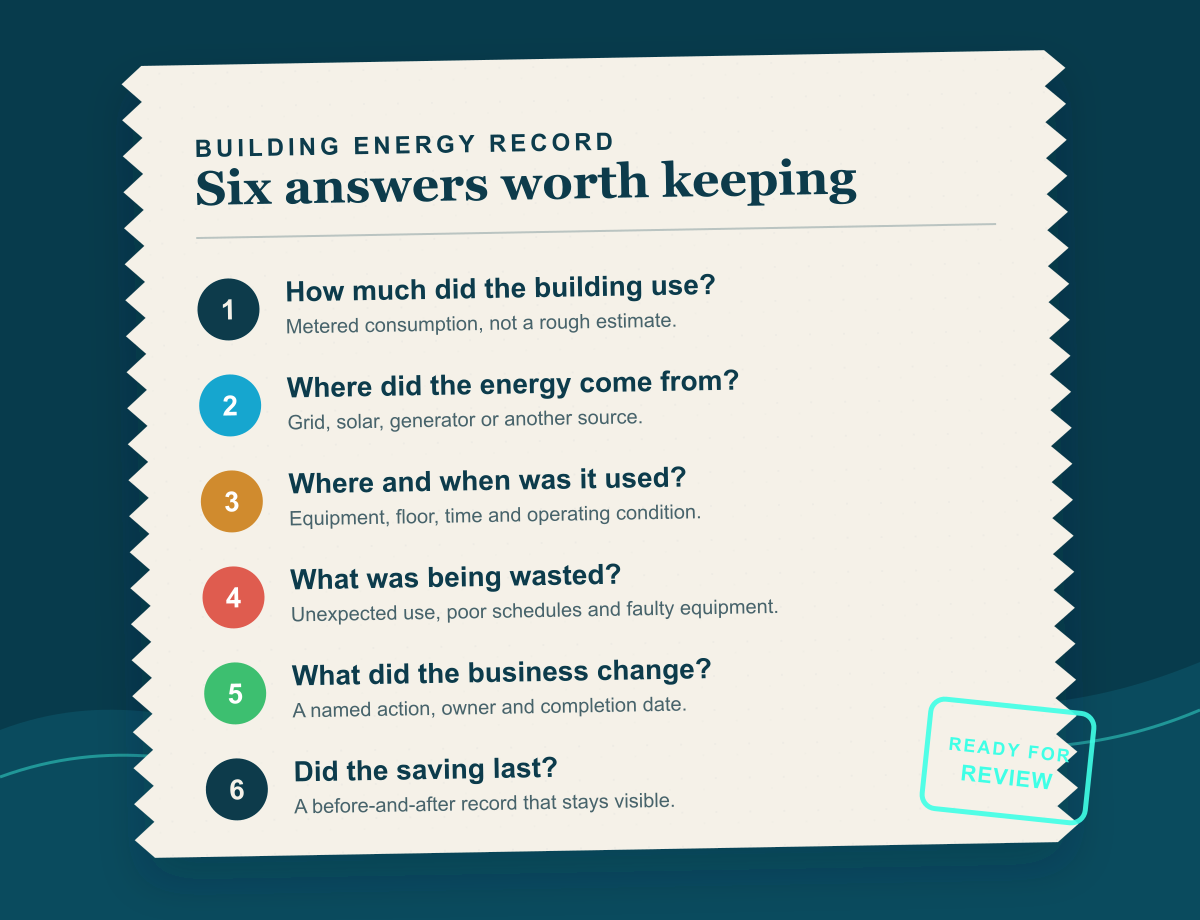
Most building owners do not need to memorise the name of every carbon framework. They need to be able to answer six practical questions:
- How much energy did each building use?
- Did it come from the grid, solar panels, a generator or another source?
- Which equipment, floor or operating period used it?
- Where was energy wasted?
- What action did the business take?
- Did the action produce a lasting reduction?
That is the working record behind most credible energy and carbon reporting. It is also the same record that helps owners reduce unnecessary cost.
Better records usually find wasted money
Compliance is often treated as paperwork. In a building portfolio, the same information can become a management tool.
If a basement ventilation system runs all night, carbon is only part of the story. The owner is also paying for wasted electricity. If a generator runs longer than planned, the owner is paying through fuel, maintenance and possible leakage. If one tower uses 25 per cent more common-area energy than another similar tower, the owner should not have to wait for a consultant's report to ask why.
Good data gives management a sharper conversation:
- Which building is costing us more than it should?
- Which equipment is running at the wrong time?
- Which saving action was completed?
- How much did it save after the change?
- Is the saving still there three months later?
That is why energy visibility matters to owners who are not excited by carbon language. It turns a vague problem into specific actions with money attached.
Where BMS and EMS fit
A Building Management System, or BMS, connects to equipment such as cooling, ventilation, pumps, lighting, meters and control panels. It can show conditions and, where configured, control the equipment locally.
An Energy Management System, or EMS, focuses on how energy is being used. It helps the business compare consumption, find waste and track improvement.
Many buildings already have part of this foundation. The issue is that owners rarely see the full estate in one clear view. A site may have Niagara. Another may have a different BMS. Some equipment may speak BACnet, Modbus, MQTT or another protocol. Solar, generator, water and utility data may sit outside the BMS completely.
This is where the right engineering and intelligence partner matters.
How AURMAK supports the work
AURMAK helps building owners and operators make their buildings easier to measure, manage and improve.
The work can start in different places. Some clients need meters, sensors, gateways, cabling, panels, protocol integration and local BMS or EMS commissioning. Some already have usable systems but need a clearer portfolio view. Some need both the physical engineering layer and a cloud intelligence layer.
That cloud platform is called AURMAK Pulse.
Pulse brings building information into one place, helps teams understand where energy is being used, highlights waste, tracks saving actions and keeps evidence ready for reporting.
The route depends on the condition of the building and what the owner wants to achieve.
Systems integration
Some buildings need the physical system first. AURMAK can deliver sensors, meters, gateways, cabling, control panels, protocol integration, local supervision and commissioning. The completed BMS or EMS can then be handed over to the client for local operation and control.
This route gives the building a reliable data and control foundation.
Pulse over existing building data
Some owners already have meters, sensors, IoT devices or a BMS. Pulse can sit above that infrastructure as an observation and intelligence layer, without replacing equipment that is already doing its job.
Pulse can receive information from systems and sources such as Niagara, BACnet, Modbus, MQTT, energy meters, weather services, tariffs, files and manual records. It then helps the business understand what the data means.
Systems integration with Pulse
Where a building has gaps, AURMAK can install or integrate the required physical equipment and connect it to Pulse. Local systems continue to handle equipment control. Pulse provides the portfolio view, analysis, fault detection, saving actions and reporting evidence.
This combined route works well when an owner wants one partner responsible for both the building-data foundation and the intelligence placed above it.
What the owner sees
Pulse can show grid electricity, solar production, generator use and other sources in the same place. This gives the owner a clearer record of total consumption and where that energy came from.
It can compare buildings, operating periods and equipment patterns, so the team can see which asset needs attention first.
It can turn a finding into a practical action: correct a schedule, investigate a meter, check a pump cycle, review generator fuel use or inspect a solar fault.
Once the action is done, the business can compare performance before and after the change. That matters because a saving is only useful if it can be seen, trusted and repeated.
A safer way to build building intelligence
For many owners, the best first step is visibility before remote control.
AURMAK can keep equipment control inside the local BMS or EMS, where site teams and approved controls contractors already manage the building. Pulse then sits above that layer to observe, analyse, flag waste, record actions and show whether improvements worked.
This approach gives owners better information without changing the control philosophy of the building on day one. It also makes the project easier to phase. A building can start with metering and monitoring, then add deeper integration as the owner becomes more comfortable with the system.
What global rules are already asking for
There is no single global building-energy law. The rules depend on where an organisation operates, the size and use of its buildings, and the amount of energy it consumes.
The examples below come from different markets, but they show the same direction: buildings are expected to keep better energy data, prove performance and show what has been done to reduce waste.
European Union
The EU's revised Energy Performance of Buildings Directive is pushing the building stock towards zero emissions by 2050. It covers areas including energy performance, building automation, solar energy, indoor environmental quality and the monitoring of technical building systems.
For larger non-residential buildings, the directive places growing importance on systems that can monitor and analyse energy use, compare performance, find losses and inform the people responsible for the building. Each EU country must put the directive into its own national law, so the detailed obligations will vary.
The EU Energy Efficiency Directive also requires certain high-energy-use businesses to operate an energy management system or carry out energy audits. The underlying requirement is sensible: decisions should be based on recent, measured and traceable operating data.
United Kingdom
The UK's Streamlined Energy and Carbon Reporting framework requires organisations within scope to include energy and carbon information in their annual reports.
Large organisations may also fall under the Energy Savings Opportunity Scheme. ESOS assessments examine energy use, identify saving opportunities and require evidence to be retained. Current guidance also covers action plans and progress updates after an assessment.
This matters because finding a possible saving once is no longer enough. A business may need to record what it decided to do and report the progress that followed.
United Arab Emirates
The UAE's Federal Decree-Law No. 11 of 2024 created a national legal framework for reducing the effects of climate change. Designated emissions sources can be required to measure emissions, submit information and retain records. The detailed responsibility depends on how the relevant authority applies the law to the organisation and its activities.
Dubai's Al Sa'fat Green Building System also sets requirements for new buildings in areas such as energy, water, building services, health and safety.
For owners and developers, the practical message is straightforward. Building performance data is becoming part of normal property management, not a separate environmental exercise completed once a year.
A useful example from the United States
New York City's Local Law 97 sets emissions limits for many large buildings and requires annual reporting. It is a city law, not a rule for the whole United States, but it shows where building regulation can lead: measured performance, a defined limit and a financial consequence for exceeding it.
Where should a building owner start?
Start with one building and one month of information:
- electricity bills and meter readings
- generator run-hours and fuel purchases
- solar production, if installed
- the main equipment schedules
- floor area and normal operating hours
- any existing BMS or gateway data
The first goal is not a perfect carbon report. It is a trustworthy picture of how the building uses energy today.
Once that picture exists, the business can find waste, set sensible targets and build a stronger evidence trail month by month.
The practical outcome
Energy and carbon rules will continue to differ between markets. Their shared direction is unlikely to reverse. Building owners will need better data, clearer responsibility and proof that improvements are real.
AURMAK gives owners a practical choice. We can deliver and hand over the local BMS or EMS, connect Pulse to systems already in place, or provide the physical and cloud layers together.
When Pulse is included, owners and operating teams gain one place to understand performance across their buildings. It connects available sources, highlights waste, turns findings into practical actions and tracks the result.
The aim across all routes is the same: reliable building information, lower unnecessary energy use and clearer evidence of improvement.
To discuss which AURMAK delivery route fits your buildings, visit aurmak.io.
Official sources
All regulatory links in this article point to the responsible government or legislative publisher. They were checked on 15 August 2026. Regulations can change, and local implementation may add further requirements.
- EU Energy Performance of Buildings Directive, consolidated version dated 24 May 2026
- EU Energy Efficiency Directive, consolidated version dated 5 August 2026
- UK environmental reporting and SECR guidance
- UK Energy Savings Opportunity Scheme guidance, updated 16 February 2026
- UAE Federal Decree-Law No. 11 of 2024
- Dubai Municipality Al Sa'fat Green Building System
- New York City Department of Buildings Local Law 97 guidance
This article provides general information. Compliance decisions and statutory submissions should be checked with the relevant professional advisers for the organisation, building type and location.
Discuss the right route for your buildings.
AURMAK can deliver the local BMS/EMS layer, connect Pulse to systems already in place, or provide the physical and cloud layers together.
Start a conversation